
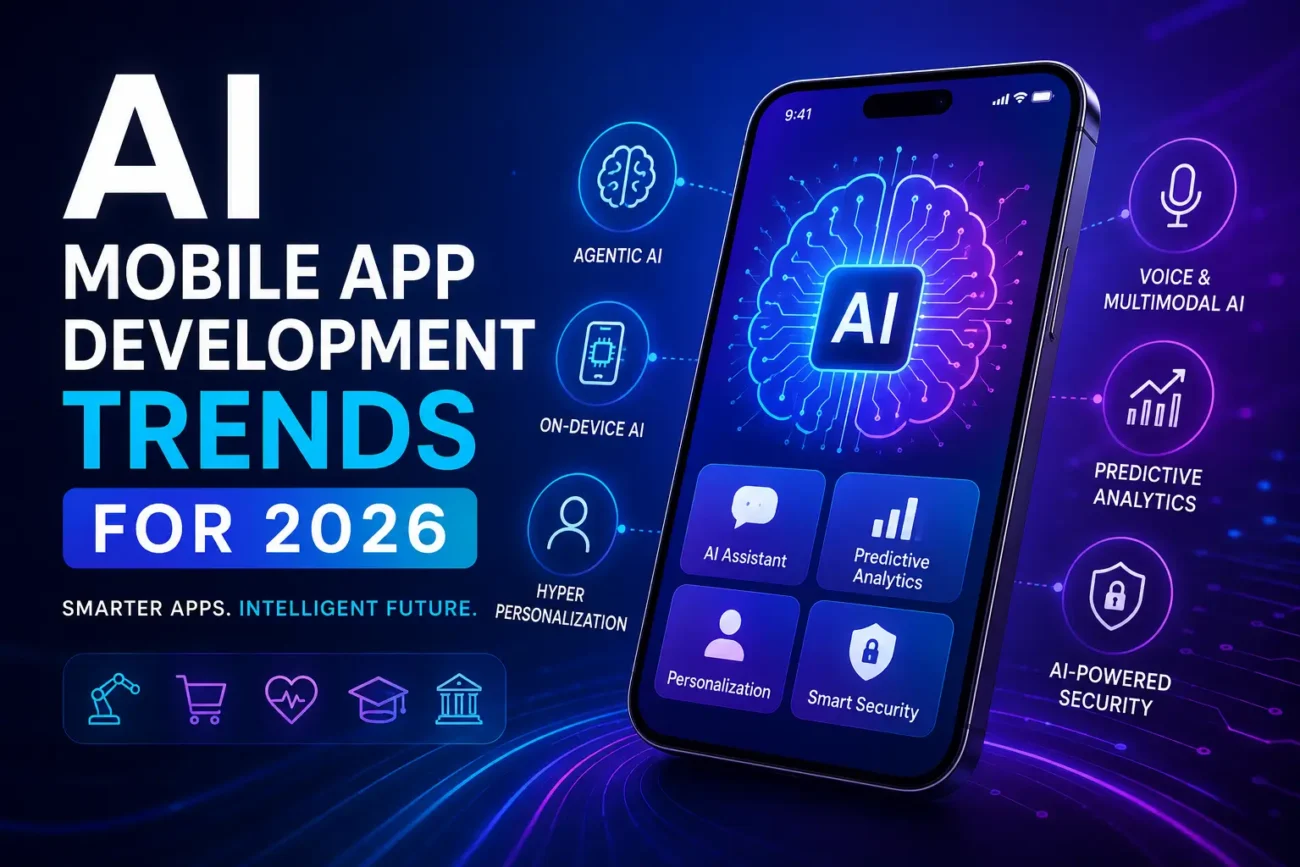
Artificial Intelligence (AI) has moved far beyond being just another feature in mobile applications. In 2026, AI is becoming the foundation of how modern apps are built, personalized, secured, and optimized. Businesses are no longer asking whether they should integrate AI—they’re asking how quickly they can implement it to stay ahead of competitors.
From intelligent virtual assistants and predictive analytics to AI-powered automation and real-time personalization, the mobile app industry is entering a new era where smart applications are becoming the standard rather than the exception.
In this guide, we’ll explore the biggest AI mobile app development trends for 2026, how they are transforming industries, and what developers and businesses should focus on when building next-generation mobile applications.
Why AI Is Dominating Mobile App Development in 2026
Consumers expect apps to understand their behavior, provide personalized experiences, and automate repetitive tasks. AI makes all of this possible.
Businesses are investing heavily in AI because it offers:
- Better customer engagement
- Higher user retention
- Improved operational efficiency
- Smarter business decisions
- Increased revenue opportunities
- Enhanced security
The combination of faster mobile processors, edge AI, cloud computing, and powerful large language models (LLMs) has made advanced AI features accessible even for small businesses.
1. Agentic AI Is Becoming the New Standard
One of the biggest trends in 2026 is the rise of Agentic AI.
Unlike traditional chatbots that simply answer questions, AI agents can complete tasks independently.
Examples include:
- Booking appointments
- Ordering products
- Managing schedules
- Writing emails
- Completing forms
- Comparing prices
- Researching information
Instead of giving users information, AI agents perform actions on behalf of users.
This significantly improves productivity and user satisfaction.
2. On-Device AI Is Replacing Cloud Dependency
Privacy has become one of the biggest concerns in mobile app development.
Instead of sending every request to cloud servers, modern smartphones can now run powerful AI models directly on the device.
Benefits include:
- Faster responses
- Better privacy
- Offline functionality
- Lower server costs
- Reduced latency
On-device AI is becoming especially important for:
- Healthcare apps
- Banking apps
- Government services
- Productivity tools
3. Hyper-Personalization Through AI
Generic user experiences are disappearing.
Modern AI apps continuously learn from user behavior to provide unique experiences for every individual.
Examples include:
Shopping Apps
- Personalized recommendations
- Dynamic pricing
- Smart search
- AI styling suggestions
Fitness Apps
- Customized workout plans
- Nutrition guidance
- Recovery recommendations
Education Apps
- Adaptive learning
- Personalized quizzes
- Individual study plans
Users now expect apps to understand their preferences automatically.
4. Multimodal AI Is Transforming User Interaction
Users no longer want to interact with apps using only text.
Multimodal AI combines:
- Voice
- Images
- Video
- Text
- Documents
A single mobile app can now understand all these input types simultaneously.
Example:
A user can:
- Upload a photo
- Ask a question using voice
- Attach a document
- Receive both text and visual responses
This creates far more natural user experiences.
5. AI-Powered Voice Interfaces Continue Growing
Voice technology has become much more accurate in 2026.
Instead of simple voice commands, users can now hold natural conversations with apps.
Popular use cases include:
- Voice shopping
- Travel booking
- Customer support
- Medical consultation
- Smart home control
- Language translation
Natural voice interaction is becoming an essential feature rather than an optional one.
6. Predictive Analytics Is Improving Business Decisions
AI now predicts user behavior before users even make decisions.
Mobile applications use predictive analytics to forecast:
- Customer purchases
- Subscription cancellations
- Product demand
- Fraud attempts
- Health risks
- Maintenance needs
Businesses use these insights to improve customer satisfaction and maximize revenue.
7. AI-Generated UI and Dynamic Interfaces
Static app interfaces are becoming outdated.
AI can now generate dynamic user interfaces based on user behavior.
For example:
- Frequently used buttons move closer.
- Recommended features appear automatically.
- Layouts adjust for accessibility.
- Font sizes adapt intelligently.
Every user may see a slightly different interface optimized for their needs.
8. AI Security Is Stronger Than Ever
Cyber threats continue evolving.
AI-powered security systems can now detect suspicious activity almost instantly.
Features include:
- Behavioral authentication
- Continuous identity verification
- AI fraud detection
- Malware detection
- Risk scoring
- Smart device monitoring
Instead of relying only on passwords, apps continuously verify whether the current user behaves like the legitimate account owner.
9. AI Coding Assistants Accelerate Development
Developers themselves are using AI more than ever.
Modern AI coding assistants help with:
- Writing code
- Debugging
- Documentation
- Test generation
- Performance optimization
- Code reviews
This significantly reduces development time while improving code quality.
Rather than replacing developers, AI is increasing their productivity.
10. AI-Powered Customer Support Is More Human
Customer support chatbots have evolved dramatically.
Modern AI assistants understand:
- Context
- Intent
- Conversation history
- Customer emotions
- Product knowledge
Instead of scripted responses, AI now provides meaningful, personalized assistance while seamlessly handing off complex issues to human agents when needed.
11. Generative AI Creates Content Instantly
Generative AI has become a built-in feature across many mobile apps.
Users can now generate:
- Images
- Videos
- Product descriptions
- Social media captions
- Marketing content
- Emails
- Presentations
- Meeting summaries
This improves productivity across industries including marketing, education, design, and business operations.
12. AI Is Driving Healthcare Mobile Apps
Healthcare remains one of the fastest-growing AI sectors.
Modern healthcare apps can assist with:
- Symptom checking
- Medication reminders
- Remote patient monitoring
- Mental wellness support
- Medical documentation
- Appointment scheduling
While AI enhances healthcare services, medical decisions should always involve qualified healthcare professionals.
13. Retail Apps Are Becoming Intelligent Shopping Assistants
Shopping apps now act as personal AI assistants.
Features include:
- Smart product discovery
- Virtual try-ons
- Personalized recommendations
- Inventory forecasting
- AI price comparison
- Purchase predictions
Retail businesses using AI often see higher conversion rates and improved customer loyalty.
14. AI and Augmented Reality Work Together
AI combined with Augmented Reality (AR) creates immersive experiences.
Popular examples include:
- Virtual furniture placement
- Makeup try-ons
- Interior design previews
- Fashion fitting
- Educational simulations
- Interactive gaming
This combination is expected to expand across multiple industries throughout 2026.
15. Responsible AI and Ethical Development
As AI becomes more powerful, responsible development is increasingly important.
Businesses should focus on:
- Transparent AI decisions
- User consent
- Data privacy
- Bias reduction
- Fair recommendations
- Secure data handling
Building trust is becoming just as important as building intelligent features.
Industries Benefiting Most from AI Mobile Apps
| Industry | AI Applications |
|---|---|
| Healthcare | Diagnosis support, patient monitoring, virtual assistants |
| Finance | Fraud detection, investment insights, smart banking |
| Education | Adaptive learning, tutoring, assessment |
| Retail | Product recommendations, inventory management |
| Logistics | Route optimization, delivery predictions |
| Manufacturing | Predictive maintenance, quality control |
| Travel | AI itinerary planning, customer support |
| Real Estate | Property recommendations, virtual tours |
Benefits of AI Mobile App Development
Organizations adopting AI-powered mobile apps can expect several advantages:
- Improved customer experience
- Increased automation
- Faster business processes
- Better decision-making through analytics
- Enhanced security
- Reduced operational costs
- Greater customer retention
- Competitive market advantage
Challenges Developers Should Consider
Despite its advantages, AI implementation comes with challenges:
- High-quality data requirements
- AI model training costs
- Privacy compliance
- Ethical concerns
- Battery optimization
- Integration complexity
- Continuous model updates
Planning for these challenges early helps ensure successful deployment.
Best Practices for Building AI Mobile Apps in 2026
To maximize the impact of AI, developers should:
- Start with a clear business problem rather than adding AI for novelty.
- Prioritize user privacy and transparent data practices.
- Optimize AI models for speed and battery efficiency.
- Use a combination of on-device and cloud AI where appropriate.
- Continuously monitor model performance and user feedback.
- Test AI features with diverse user groups to reduce bias.
- Keep interfaces simple so AI enhances, rather than complicates, the user experience.
The Future of AI Mobile Apps
Looking beyond 2026, mobile applications will become increasingly autonomous. AI will move from simply responding to user commands to anticipating needs, coordinating tasks across multiple apps, and delivering deeply personalized experiences.
Advances in edge computing, multimodal intelligence, wearable devices, and AI agents will continue to reshape how people interact with technology. Businesses that invest in scalable, ethical AI solutions today will be better positioned to adapt to tomorrow’s innovations.
Frequently Asked Questions (FAQs)
What is AI mobile app development?
AI mobile app development is the process of building mobile applications that use artificial intelligence technologies such as machine learning, natural language processing, computer vision, and predictive analytics to provide intelligent features and personalized experiences.
Which industries benefit most from AI mobile apps?
Healthcare, finance, retail, education, logistics, travel, manufacturing, and real estate are among the industries seeing the greatest benefits from AI-powered mobile applications.
Is on-device AI better than cloud AI?
Both approaches have advantages. On-device AI offers faster performance, lower latency, and better privacy, while cloud AI provides greater computing power for complex tasks. Many modern apps use a hybrid approach.
Are AI mobile apps secure?
When built with strong encryption, secure authentication, and responsible AI practices, AI-powered mobile apps can enhance security through real-time threat detection and fraud prevention.
Should small businesses invest in AI mobile apps?
Yes. AI tools and frameworks have become more accessible, allowing startups and small businesses to add intelligent features such as customer support, recommendations, automation, and analytics without enterprise-level budgets.
Conclusion
AI mobile app development in 2026 is centered on creating smarter, faster, and more personalized digital experiences. Trends such as agentic AI, on-device intelligence, multimodal interaction, predictive analytics, adaptive interfaces, and ethical AI are redefining what users expect from mobile applications.
Organizations that embrace these innovations while maintaining a strong focus on privacy, transparency, and user value will be well-positioned to build applications that stand out in an increasingly competitive market. Rather than treating AI as an optional feature, successful businesses are making it a core part of their mobile strategy to drive growth, improve customer satisfaction, and prepare for the future.
