
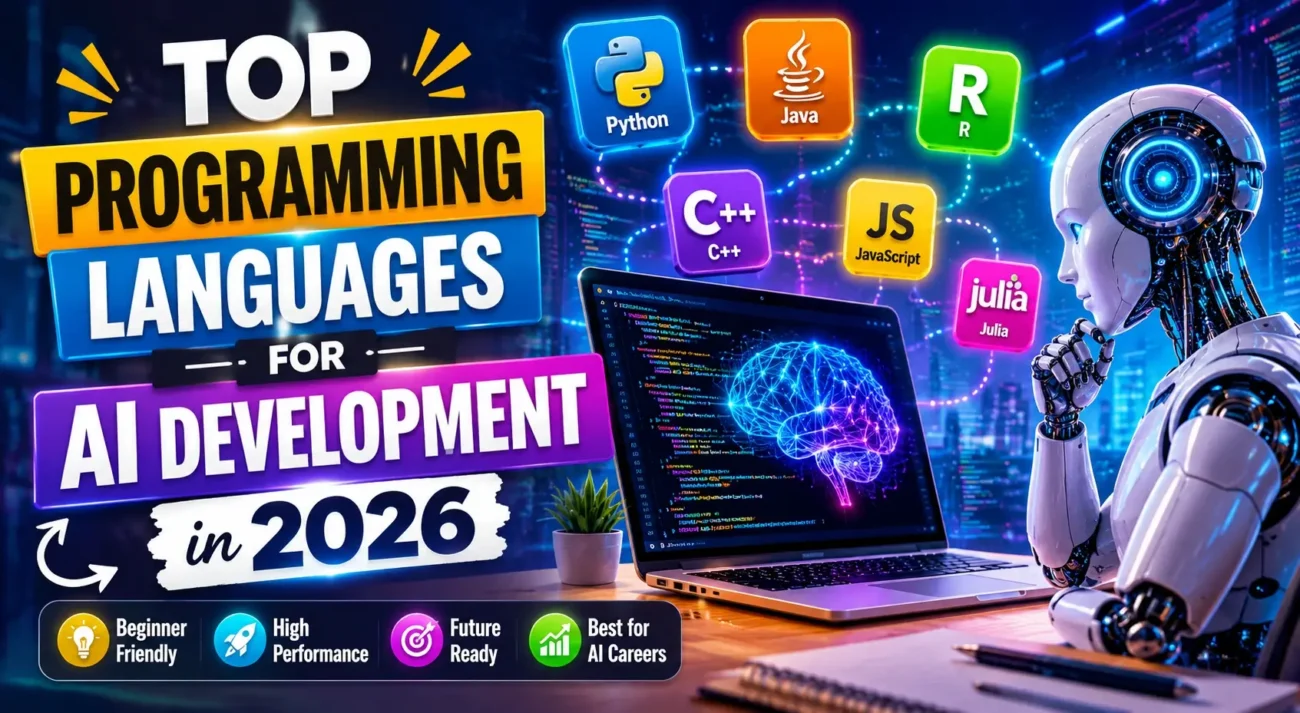
Artificial Intelligence is changing the world faster than ever before. From smart chatbots to self-driving cars, AI is now part of daily life. Businesses, developers, and students all want to learn the best tools for building AI systems.
But here is the truth many beginners do not know:
Choosing the right programming language can make AI development easier, faster, and more successful.
A few years ago, many developers focused only on websites or mobile apps. Today, AI skills are becoming one of the highest-paying tech careers in the world. Companies are investing billions into machine learning, automation, robotics, and data science.
That is why developers now ask an important question:
Which are the top programming languages for AI development in 2026?
In this guide, you will learn the best AI programming languages, their strengths, real-world uses, and why big tech companies rely on them. Whether you are a beginner or an experienced coder, this article will help you choose the right path.
Why Programming Languages Matter in AI
Artificial Intelligence depends heavily on data processing, algorithms, and automation. Different programming languages offer different benefits.
Some languages are easier to learn. Others are better for speed or large-scale AI systems.
The right language helps developers:
- Build machine learning models faster
- Handle big data efficiently
- Create smart automation tools
- Develop neural networks
- Improve AI performance
- Reduce development time
Modern AI development also requires strong support from libraries, frameworks, and developer communities.
For example:
- Python works well with TensorFlow and PyTorch
- Java is common in enterprise AI systems
- R is popular in data science and analytics
This is why understanding programming languages is important before starting AI projects.
Top Programming Languages for AI Development in 2026
Comparison Table
| Programming Language | Best For | Difficulty Level | Popular AI Use Cases |
| Python | Machine learning and deep learning | Easy | Chatbots, NLP, automation |
| Java | Enterprise AI systems | Medium | Banking AI, large apps |
| R | Data analysis and statistics | Medium | Data science, prediction |
| C++ | High-performance AI | Hard | Robotics, gaming AI |
| JavaScript | AI in web applications | Easy | Browser AI tools |
| Julia | Scientific computing | Medium | AI research |
| Lisp | AI research | Hard | Symbolic AI |
| Prolog | Logic-based AI | Hard | Expert systems |
Python: The King of AI Development
Why Python Dominates AI
Python is currently the most popular AI programming language in the world.
It is simple, clean, and beginner-friendly. Even people with little coding experience can start learning Python quickly.
Big companies like Google, OpenAI, and Netflix use Python for AI projects.
Key Advantages of Python
- Easy syntax
- Huge AI community
- Thousands of AI libraries
- Fast development process
- Excellent machine learning support
Popular Python AI Frameworks
- TensorFlow
- PyTorch
- Scikit-learn
- Keras
- Pandas
Python is perfect for:
- Machine learning
- Deep learning
- Natural language processing
- AI automation
- Computer vision
According to Python Official Website, Python continues to grow as one of the most widely used programming languages globally.
Java for Enterprise Artificial Intelligence
Java remains a strong choice for AI development, especially for enterprise software.
Large companies prefer Java because it is stable, secure, and scalable.
Banks, healthcare systems, and large corporations often use Java-powered AI tools.
Benefits of Java in AI
- Strong performance
- High security
- Cross-platform support
- Reliable for large systems
Java works well for:
- AI-powered business software
- Fraud detection systems
- Recommendation engines
- Cloud-based AI platforms
Java also supports machine learning libraries like:
- Deeplearning4j
- Weka
- MOA
R Programming for Data Science and AI
R is famous in the world of statistics and data analysis.
Data scientists often choose R because it handles data visualization and analytics extremely well.
Why R Is Important in AI
Artificial intelligence depends on data. R makes it easier to analyze large datasets and discover patterns.
Best Uses of R
- Predictive analytics
- Statistical modeling
- Data mining
- AI research
- Data visualization
R is widely used in universities and research centers.
C++ for High-Speed AI Applications
Not every AI system can rely on easy programming languages.
Some AI applications require speed and high performance. That is where C++ becomes important.
Why C++ Is Still Valuable
C++ gives developers greater control over hardware and memory.
This makes it useful for:
- Robotics
- Self-driving cars
- AI gaming engines
- Real-time simulations
Many advanced AI engines still use C++ behind the scenes because performance matters.
JavaScript and AI-Powered Web Apps
JavaScript is no longer only for websites.
Today, developers can build AI-powered web applications directly inside browsers.
JavaScript AI Advantages
- Works in browsers
- Great for interactive AI tools
- Supports AI APIs
- Ideal for web automation
Popular JavaScript AI Libraries
- TensorFlow.js
- Brain.js
- Synaptic.js
AI chatbots, smart search systems, and recommendation tools often use JavaScript.
Julia: The Rising Star in AI
Julia is becoming popular among AI researchers and scientists.
It combines speed with easier syntax compared to older languages.
Why Developers Like Julia
- Very fast execution
- Great for scientific computing
- Handles complex math efficiently
- Good for machine learning research
Julia is still newer than Python, but experts believe it may grow rapidly in the future.
Lisp and Prolog in Artificial Intelligence
Before modern AI tools became popular, Lisp and Prolog were heavily used in AI research.
These languages still matter in academic and symbolic AI systems.
Lisp
Lisp is useful for:
- AI reasoning
- Symbolic processing
- Machine learning research
Prolog
Prolog is known for:
- Logic programming
- Expert systems
- Knowledge-based AI
Although less popular today, these languages helped shape modern artificial intelligence.
Factors to Consider Before Choosing an AI Language
Choosing the best AI language depends on your goals.
Here are some important things to think about.
1. Ease of Learning
Beginners usually start with Python because it is simple.
2. Performance Requirements
For high-speed systems, C++ may be better.
3. Community Support
Languages with large communities provide more tutorials and libraries.
4. AI Framework Availability
Popular AI frameworks save development time.
5. Career Opportunities
Some languages offer more job opportunities in AI development.
Best Programming Language for AI Beginners
For most beginners, Python is still the best option.
It offers:
- Easy learning curve
- Massive tutorial ecosystem
- Strong AI framework support
- Excellent job demand
Many AI engineers begin with Python before learning advanced languages later.
AI Career Opportunities in 2026
Artificial intelligence careers are growing very fast.
According to Forbes Technology, AI-related jobs continue to increase across industries.
Popular AI Careers
| Career | Average Skill Focus |
| Machine Learning Engineer | Python, TensorFlow |
| Data Scientist | Python, R |
| AI Researcher | Python, Julia |
| Robotics Engineer | C++ |
| AI Software Developer | Java, Python |
AI professionals often work in:
- Healthcare
- Finance
- Education
- Cybersecurity
- E-commerce
- Automotive industries
How Big Companies Use AI Languages
Many global companies use multiple AI programming languages together.
Examples
| Company | Main AI Languages |
| Python, C++ | |
| Meta | Python, PHP |
| Amazon | Java, Python |
| Microsoft | C++, Python |
| IBM | Java, Python |
These companies choose languages based on project needs, speed, scalability, and AI workloads.
Interesting Facts About AI Programming Languages
- Python was created in 1991.
- Lisp is one of the oldest AI languages.
- TensorFlow was developed by Google.
- AI coding jobs often pay higher salaries than traditional software jobs.
- JavaScript AI tools now run directly inside web browsers.
- AI development is becoming important in almost every industry.
Frequently Asked Questions
Which programming language is best for AI development?
Python is considered the best programming language for AI because it is easy to learn and supports many AI libraries.
Is Python enough for artificial intelligence?
Yes, Python is enough for many AI projects, especially machine learning, automation, and deep learning.
Can beginners learn AI programming?
Yes. Beginners can start with Python and gradually learn AI frameworks like TensorFlow and PyTorch.
Is Java good for AI development?
Yes. Java is excellent for enterprise AI systems and large-scale applications.
Which language is fastest for AI?
C++ is one of the fastest languages for AI applications that require high performance.
Is AI programming a good career in 2026?
Yes. AI careers are growing quickly and offer strong salaries and long-term opportunities.
What language do AI engineers use most?
Most AI engineers use Python because of its flexibility and huge ecosystem.
Does AI require advanced math?
Basic math helps, but beginners can still start learning AI step by step.
Final Thoughts
Artificial intelligence is no longer the future. It is already changing how the world works.
From healthcare to entertainment, AI systems are becoming smarter every day. But behind every successful AI tool is the right programming language.
Python continues to dominate because it is simple and powerful. Java remains important for large business systems. C++ offers high performance, while JavaScript helps create AI-powered web experiences.
The best choice depends on your goals, experience, and project needs.
If you are starting your AI journey in 2026, learning Python is one of the smartest decisions you can make. Later, you can expand into other languages as your skills grow.
The AI industry is still growing rapidly, and developers who learn these technologies today may become tomorrow’s industry leaders.
