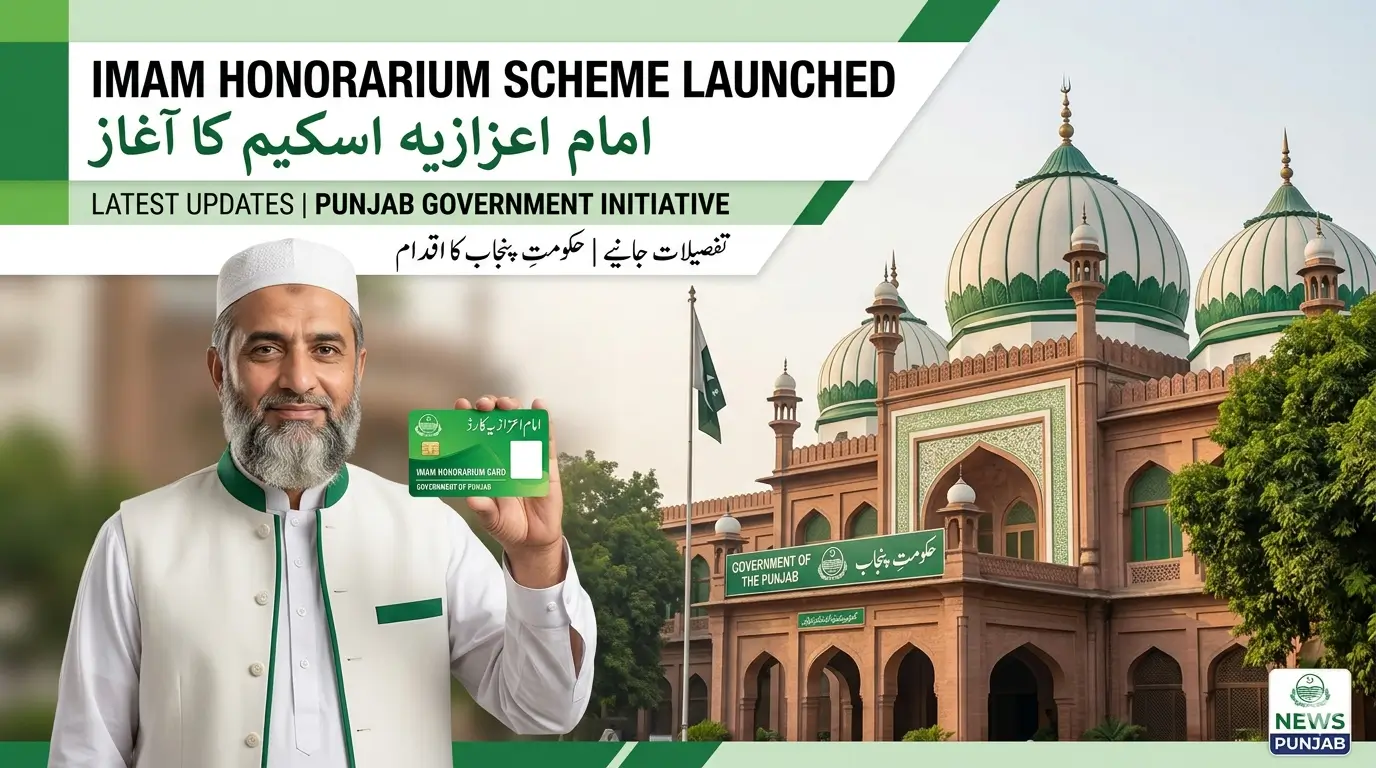
CM Punjab Schemes 2026 • Religious Welfare
CM Punjab Honorarium Cards for Imam Masjid – Complete Guide 2026
Everything you need to know about Punjab’s Rs. 25,000 monthly stipend for mosque Imams — eligibility, registration, documents, and Phase II details.
⚡ Quick Answer — Featured Snippet
The CM Punjab Honorarium Card for Imam Masjid is a welfare initiative by Chief Minister Maryam Nawaz Sharif that provides registered mosque Imams across Punjab a monthly stipend of Rs. 25,000 through a dedicated Bank of Punjab debit card. Phase I covered nearly 70,000 Imams; Phase II is now extending the programme to remaining districts and tehsils.
Introduction – A Historic Step for Punjab’s Mosque Imams
Imagine leading five daily prayers, delivering Friday Khutbas, counselling local families, and serving as the spiritual backbone of an entire neighbourhood — all while struggling to put food on the table. For decades, this has been the quiet, unspoken reality of thousands of mosque Imams across Punjab. They give everything to their communities, yet formal financial support from the government remained a distant dream.
That picture began to change in December 2025, when Punjab Chief Minister Maryam Nawaz Sharif put her stamp of approval on the Chief Minister Punjab Honorarium Card for Imam Masjid Sahib — a landmark scheme that now provides eligible mosque Imams with a guaranteed monthly income of Rs. 25,000, disbursed digitally through a dedicated debit card.
This is not just another government announcement. Payments under the Imam Masjid Honorarium Scheme began flowing from January 1, 2026, and with Phase II already launched, the programme is rapidly expanding to cover every corner of Punjab. If you are an Imam, a family member of one, or simply a concerned citizen wanting to know more, this complete guide breaks down everything — from eligibility and documents to the step-by-step application process.
What Is the CM Punjab Honorarium Card for Imam Masjid?
The CM Punjab Imam Card is a government-issued digital debit card linked to the Bank of Punjab that carries a monthly honorarium (a formal recognition payment) for mosque Imams registered in Punjab. The scheme falls under the Punjab Ministry of Religious Affairs and operates on a completely digitised, transparent platform.
In simple terms: once an Imam is verified and registered, a personalised Honorarium Card is issued in their name. Every month, Rs. 25,000 is credited directly into the account attached to that card — no middlemen, no cash counters, no unnecessary delays.
“Any Imam found involved in activities against national interests or engaged in moral or financial misconduct will have their honorarium immediately suspended.”
— CM Maryam Nawaz Sharif, High-Level Meeting, December 2025
The scheme is historic in scale. Phase I registered approximately 70,000 Imams and began disbursements through pay orders in January 2026, before switching fully to the digital card system from February 1, 2026. Phase II, launched in late January 2026, extends the programme to all divisions, districts, cities, and tehsils not covered in the first phase — including all six districts of Rawalpindi Division.
Key Features of the CM Punjab Imam Card Scheme
- Digital Debit Card System: Each verified Imam receives a personalised Bank of Punjab debit card — no physical cash distribution.
- Monthly Direct Transfer: Rs. 25,000 is deposited directly into the linked account each month, eliminating the need for Imams to visit any office.
- Centralised Verification: Digital cross-verification of identity and mosque data is carried out at district and provincial levels to prevent fraud or duplication.
- Strict Oversight Mechanism: Mosque management committees and tehsil-level management committees have been established. Assistant Commissioners hold monthly meetings with Imams to address issues on the ground.
- Misconduct Clause: Any Imam found involved in activities harmful to national interests, financial misconduct, or moral violations will have their honorarium immediately suspended.
- Phase-Wise Rollout: Phase I targeted the bulk of registered mosques; Phase II ensures no eligible Imam in any district or tehsil is left out.
- Zero Duplication Policy: No Imam can receive honorarium from more than one mosque simultaneously.
Benefits of the Punjab Government Imam Salary Program
At its core, this scheme is about dignity. For many Imams — especially those serving in smaller towns and rural areas — income has traditionally depended on community donations, which can be irregular and insufficient. The Punjab Government Imam Salary Program changes that reality in several meaningful ways.
Financial Stability
A predictable monthly income of Rs. 25,000 means an Imam can plan household expenses, pay school fees for his children, and manage medical costs without relying solely on community goodwill. For Imams in smaller villages, this monthly payment is often transformational.
Formal Recognition
Being part of a government-backed scheme formally recognises the Imam’s professional role. This can open doors to other social safety nets, housing loans, and health facilities that require proof of income or employment.
Reduced Corruption Risks
The digital payment mechanism removes layers of bureaucracy that previously created opportunities for misuse of funds. Each payment is traceable, auditable, and directly linked to a verified individual.
Community Confidence
When an Imam is financially secure, their focus can remain entirely on religious duties, community counselling, and religious education — without the distraction of financial stress. This benefits the entire community they serve.
Eligibility Criteria – Who Can Apply for the Imam Card?
✅ Basic Eligibility Requirements
- The applicant must be an officially appointed Imam at a mosque physically located within the province of Punjab.
- The mosque must be officially registered with the relevant religious or government authority. Unregistered or inactive mosques will not qualify.
- The Imam must possess a valid Pakistani CNIC that matches the identity records held by NADRA and provincial authorities.
- The Imam must not be receiving a duplicate honorarium from another mosque — one card per Imam, one Imam per mosque.
- The Imam must have a clean conduct record: no criminal background, no history of financial misconduct, and no involvement in activities deemed against national or moral interests.
- The mosque must be operational and active — mosques under renovation, long-term closure, or inactive status may not immediately qualify and require further evaluation.
- Certification of official appointment must be available from local authorities or the Auqaf Department.
Required Documents for the Imam Masjid Honorarium Scheme
The documentation process is straightforward, but getting it right the first time will save you weeks of back-and-forth. Make sure you have all of the following ready before submitting your application:
- Original CNIC (Computerised National Identity Card) — both the original and a clear photocopy.
- Mosque Registration Certificate — proof that the mosque is officially registered with the Auqaf Department or relevant local authority.
- Appointment Letter or Certificate — an official document confirming the Imam’s appointment at the specific mosque, issued by the mosque management committee or Auqaf Department.
- Recent Passport-Sized Photographs — typically two to four, depending on district office requirements.
- Mosque Details Form — mosque name, address, registration number, and number of congregants (where applicable).
- Mobile Phone Number registered on the Imam’s CNIC for verification purposes and payment notifications.
- Bank Account Details (if any pre-existing account) — though the Bank of Punjab card is primarily issued as part of the scheme itself.
Pro Tip: Make multiple photocopies of every document. Different offices may ask for different quantities. Keeping digital scans on your phone can also speed up any online verification steps.
Step-by-Step Application Process – How to Apply for the Imam Card Punjab
The government has designed a two-track application system: online registration (where available) and offline submission through local administrative offices. Here is exactly how to go about it.
Online Registration (Where Available)
According to official sources, Punjab’s Ministry of Religious Affairs has been working on a centralised digital portal to facilitate online registration for Imams. While the portal’s full public rollout is expected to be completed in conjunction with Phase II, interested Imams are advised to:
Visit the Official Punjab Government Portal
Go to the Punjab Ministry of Religious Affairs website or the CM Punjab official portal. Look for the “Imam Masjid Honorarium Card” or “CM Punjab Imam Card” registration section.
Create Your Account / Log In
Register using your CNIC number and mobile phone number (registered with NADRA). An OTP (One-Time Password) will be sent to your mobile to verify your identity.
Fill in the Application Form
Enter all required personal details, mosque information (registration number, location, district, tehsil), and your appointment details accurately.
Upload Scanned Documents
Upload clear scans or photographs of your CNIC, mosque registration certificate, and appointment letter. Ensure all images are clear and legible.
Submit & Note Your Application Number
After reviewing your form, submit it and save the application reference number. You will need this to track your application status.
Offline Application Method
For Imams who do not have access to the internet or prefer the traditional route, offline registration is also fully available through local administrative channels:
1- Visit Your Local Auqaf Department or District Office
Go to the nearest Auqaf Department office, District Religious Affairs office, or the office of your Assistant Commissioner. These are the primary collection points for registration forms across Punjab.
2- Collect and Fill the Registration Form
Obtain the official Imam Masjid Honorarium Card registration form. Fill it in carefully using a blue or black pen. Double-check all details, especially your CNIC number and mosque registration number.
3- Attach All Required Documents
Attach photocopies of your CNIC, mosque registration certificate, appointment letter, and photographs. The office staff will guide you if any additional documents are needed for your specific district.
4- Submit the Form and Receive an Acknowledgement
Hand over the completed form to the designated officer. Ask for a written acknowledgement or receipt — this is your proof of submission.
5- Wait for Verification and Card Issuance
Provincial authorities will cross-verify your data at the district and provincial level. Once cleared, your Bank of Punjab Honorarium Card will be issued and handed over through the relevant office or tehsil committee.
Salary and Financial Assistance Details
- Monthly Honorarium Amount: Rs. 25,000 per Imam per month
- Payment Method: Directly credited to a Bank of Punjab Honorarium Card (dedicated debit card)
- Initial Payment Mode (January 2026): Pay orders issued for the first month during the card rollout phase
- Ongoing Payment Mode (February 2026 onwards): Exclusively through the Imam Masjid Honorarium Card
- Total Annual Programme Cost: Estimated at Rs. 20 billion — making this one of the largest religious welfare initiatives in Punjab’s history
- Duplicate Payments: Strictly prohibited — each Imam can only receive one honorarium, for one mosque
Think of it this way: at Rs. 25,000 a month, an Imam in rural Punjab now earns more than many entry-level government employees, and the income arrives reliably, on time, without the need to chase any officer or committee. That consistency is arguably the most valuable part of this scheme.
Important Dates – Timeline of the CM Punjab Imam Card
| Date / Period | Milestone |
|---|---|
| December 3, 2025 | CM Maryam Nawaz officially approves the CM Punjab Honorarium Card for Imam Masjid Sahib |
| December 2025 | 62,994 registration forms received; verification process begins across Punjab |
| January 1, 2026 | First honorarium payments begin — issued through pay orders while card distribution is underway |
| January 8, 2026 | CM Punjab inaugurates distribution of Honorarium Cards for Aima-e-Masajid in Lahore |
| February 1, 2026 | All payments switch exclusively to the Honorarium Card system; pay orders discontinued |
| January–February 2026 | Full card issuance targeted for completion across Punjab (Phase I) |
| January 27–29, 2026 | Phase II officially launched — covering all remaining districts and tehsils, including Rawalpindi Division |
| Ongoing 2026 | Phase II registration continues; monthly meetings between ACs and Imams established |
Government Objectives Behind the Mosque Imam Financial Support Scheme
Understanding why this scheme was launched helps appreciate its full importance. The Punjab government has outlined several clear goals behind the Mosque Imam Financial Support Pakistan initiative:
1. Eliminating Financial Insecurity Among Religious Leaders
Mosque Imams have historically been among the most financially vulnerable segments of society, despite playing a crucial social and spiritual role. This scheme directly addresses that gap by guaranteeing a regular income.
2. Replacing Outdated, Corruption-Prone Systems
Previous manual payment systems involved multiple layers of intermediaries, often resulting in delays, underpayments, and opportunities for corruption. The digital card system centralises and automates payments, dramatically reducing these risks.
3. Maintaining Oversight and Accountability
By issuing honorariums only to verified, officially appointed Imams of registered mosques, the government creates a structured, accountable network. The monthly meetings between Assistant Commissioners and Imams further institutionalise this relationship.
4. Promoting Social Cohesion and Community Development
Financially secure Imams can focus entirely on their religious and community roles — delivering meaningful Khutbas, offering counselling, running madrassas, and fostering peace within communities. The scheme is as much an investment in community stability as it is in individual welfare.
5. Building a Provincial Digital Welfare Framework
This initiative is part of a broader push by the Punjab government to digitise welfare disbursements — reducing paperwork, improving data quality, and creating a foundation for future welfare expansions such as health cover or training programs for religious leaders.
Common Mistakes to Avoid While Applying
Avoid these errors that could delay or disqualify your application for the CM Punjab Imam Card.
- Applying with an Expired CNIC: Your CNIC must be valid and active. An expired ID will result in immediate rejection during digital verification.
- Submitting Documents for an Unregistered Mosque: Many Imams make this mistake. If the mosque is not registered with the Auqaf Department, the application cannot proceed. Register the mosque first.
- Providing Mismatched Information: Ensure that the name, CNIC number, and father’s name on your application exactly match your CNIC and NADRA records. Even minor discrepancies (spelling differences, for example) can cause delays.
- Registering for Multiple Mosques: The scheme strictly prohibits receiving an honorarium from more than one mosque. Attempting to register for multiple mosques will result in suspension of benefits and may trigger a misconduct inquiry.
- Ignoring the Acknowledgement Receipt: Always ask for a written receipt or application reference number when submitting your form offline. Without it, tracking your application becomes extremely difficult.
- Submitting Blurry or Incomplete Document Scans: For online applicants, ensure all uploaded documents are clearly photographed, well-lit, and fully legible. Poor-quality scans are a leading cause of processing delays.
- Not Updating Contact Information: The mobile number on your application must be active and registered to your CNIC. This is used for OTP verification and payment notifications.
Frequently Asked Questions (FAQs) – CM Punjab Imam Card 2026
Conclusion – A New Chapter for Punjab’s Mosque Imams
The CM Punjab Honorarium Card for Imam Masjid is more than a welfare payment — it is a statement of intent from the Punjab government that the contributions of religious leaders will no longer go unrecognised or unrewarded. With Rs. 25,000 a month landing directly in an Imam’s Bank of Punjab account, financial worry can no longer be a barrier to faithful service.
For thousands of Imams in rural towns and small tehsils who have waited years for this kind of formal support, Phase II of the scheme is particularly significant. The government’s commitment to covering all remaining districts — including Rawalpindi Division — shows that this is not just a Lahore-centric initiative but a truly province-wide reform.
If you or someone you know is an Imam at a registered mosque in Punjab, do not delay. Gather your documents, visit your nearest Auqaf or District office, and begin the registration process. Financial stability is now within reach.